
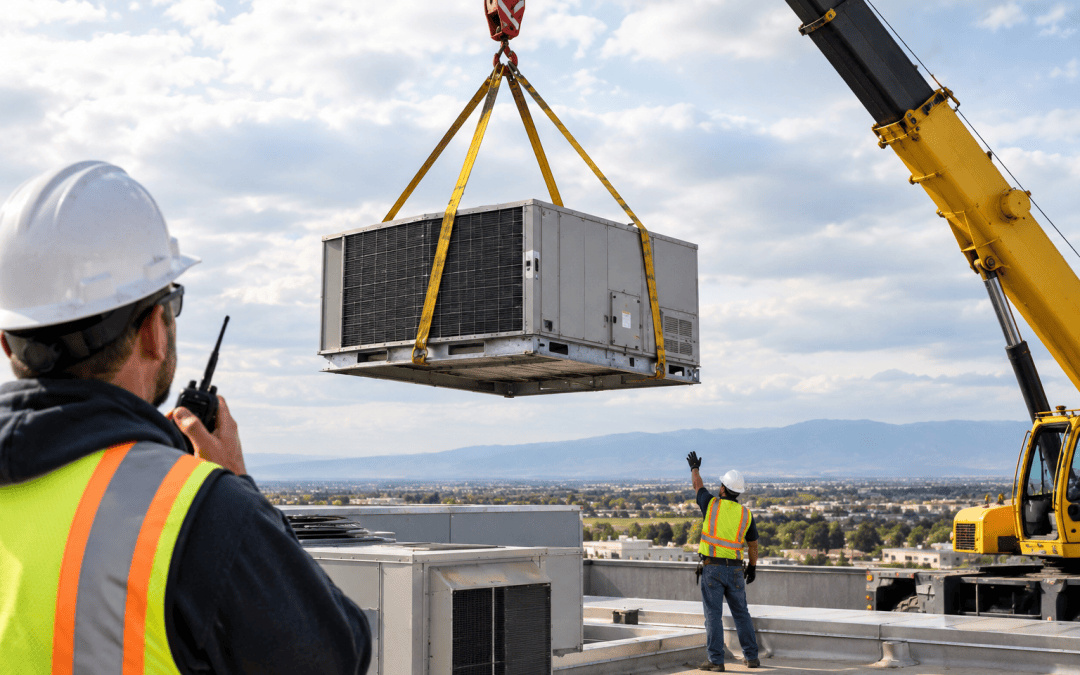
When your commercial rooftop unit fails and the replacement quote includes a line item for “crane service,” the number can be startling. Five figures aren’t uncommon. And if you’ve never replaced a rooftop unit before, it’s natural to wonder whether you’re being upsold.
You’re not.
Crane-lift rooftop AC install cost reflects real logistics, real equipment, and real risk. Understanding what drives that price helps you budget accurately—and avoid contractors who lowball the estimate, then hit you with change orders on install day.
Here’s what actually goes into a crane lift, why some buildings need one, and what to expect when the crane shows up.
Why Some Rooftop Units Require a Crane Instead of a Standard Lift
Most small commercial rooftop units—3 to 7.5 tons—can be hoisted using a portable crane or even rigged manually if the building is low and access is clear. But once you cross into larger tonnage, taller buildings, or restricted access, a mobile crane becomes the only safe option.
Unit weight is the primary driver. A 15-ton packaged rooftop unit can weigh 2,500 pounds or more. A 25-ton unit can push 4,000 pounds. Standard hoists and portable cranes have weight limits, and exceeding them isn’t just unsafe—it’s illegal under OSHA regulations.
Roof height matters. A two-story building with clear access might allow a smaller crane or hoist. A four-story building with parapet walls and limited clearance requires a mobile crane with enough boom reach to clear the structure and place the unit precisely.
What Factors Drive Crane Cost: Unit Weight, Roof Height, Street Access
Crane rental isn’t a flat rate. The cost depends on the size of the crane, how long it’s on-site, and what it takes to position it safely.
Crane size and capacity. Smaller cranes—25 to 40 tons—cost less than larger 60- to 100-ton cranes. The crane size you need depends on the weight of the unit, the height of the lift, and the horizontal distance from the crane’s position to the roof. A heavier unit on a taller building requires a bigger crane, which means higher rental rates.
Permitting and Street-Closure Considerations for Crane Day
If your building sits on a busy street or in a downtown area, crane day involves more than just showing up with equipment.
Street-use permits. If the crane needs to occupy a public street or sidewalk, you’ll need a permit from the city. In Fresno, that means coordinating with the Public Works Department, submitting a site plan, and paying permit fees. Processing time varies, but plan for at least a week—sometimes longer during busy construction seasons.
Traffic control and signage. If the crane blocks a lane or requires a full street closure, you’ll need traffic cones, barricades, and possibly flaggers to redirect vehicles and pedestrians. Some cities require licensed traffic-control companies to handle this. That’s another line item.
How Crane Cost Fits Into the Total Replacement Budget
Crane service is a significant cost, but it’s one piece of a larger project. Understanding how it fits into the total budget helps you evaluate quotes accurately.
Typical crane cost range. For most commercial rooftop replacements in the Central Valley, crane service runs between $3,000 and $8,000, depending on the factors listed above. Larger cranes, longer lifts, or complicated access can push costs higher.
Crane cost as a percentage of total project cost. On a $30,000 rooftop unit replacement, a $5,000 crane lift represents about 17% of the total. On a $60,000 replacement involving a larger unit, the crane might still be $6,000—now just 10% of the total. The crane cost doesn’t scale linearly with equipment cost.
What to Expect on Crane-Lift Day
Crane day is dramatic. It’s also carefully choreographed. Here’s what happens.
Pre-lift site prep. Before the crane arrives, your contractor will stage the new unit, disconnect and prepare the old unit for removal, and verify that the roof structure can support the new equipment. Rigging straps, lifting points, and safety equipment are inspected and positioned.
Crane arrival and setup. The crane arrives early—often before business hours to minimize disruption. The operator positions the crane, extends outriggers for stability, and verifies clearances. This can take 30 to 60 minutes.
Old unit removal. The crane lifts the old unit off the roof and lowers it to ground level, where it’s loaded onto a truck for disposal. This is the moment when any miscalculations about weight, balance, or clearance become obvious. A good crew has already accounted for all of this.
How to Tell in Advance If Your Building Will Need a Crane
You don’t have to wait for a quote to know whether a crane is likely. A few factors make it predictable.
Unit size and weight. If your rooftop unit is 12.5 tons or larger, assume a crane will be needed. Smaller units might avoid it depending on other factors, but larger units almost always require one.
Building height. Three stories or taller usually means a crane. Two stories might go either way depending on access and unit weight.
Roof access. If there’s no clear path from ground level to the roof—no loading dock, no wide stairwell, no adjacent structure—a crane is the only option.
Conclusion
Your HVAC services in Fresno experts know this allows you to focus on what really counts – creating lasting memories with loved ones. These temperature management techniques will turn your gatherings from temperature battles into perfectly balanced celebrations.
Ready to experience the maximum comfort and efficiency for your HVAC needs? Contact your HVAC contractor in Fresno, Maximum Air today at (559) 222-0733 and let our expert team take care of all your heating and cooling requirements. Don’t settle for anything less than the best – choose Maximum Air for superior service, reliable solutions, and unmatched customer satisfaction. Call us now and discover why we are the trusted choice for HVAC services in Fresno.
Frequently Asked Questions
Q: Why do some rooftop replacements need a crane and others don’t?
A: It usually comes down to unit weight, roof height, and whether there’s safe access for a standard hoist—heavier multi-ton units on tall buildings almost always need a crane.
Q: Does a crane lift require street closures?
A: Sometimes, depending on the building’s location and how much space the crane needs to set up—this is coordinated in advance with the city if required.
Q: Is crane-lift cost included in a standard replacement quote?
A: It should be itemized separately since it depends on site-specific factors—a transparent quote will break this out rather than bundling it in.
